South Jeolla Taps Doosan Enerbility to Accelerate Korea Offshore Wind Supply Chain
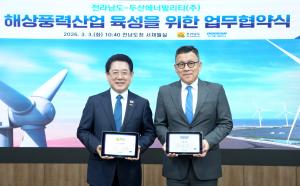
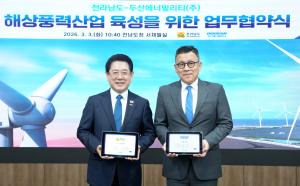
South Jeolla Province signed an MOU with Doosan Enerbility to promote offshore wind and deepen public–private coordination on projects and local manufacturing. The move targets faster development and stronger domestic supply chains.
Executive Insight
South Jeolla Province’s MOU with Doosan Enerbility is a clear signal that Korea’s offshore wind build-out is becoming increasingly policy-orchestrated at the provincial level, not only through permitting support but also via industrial policy aimed at anchoring more value locally. For a region that sits at the center of Korea’s offshore wind resource potential, tighter public–private alignment can translate into faster project maturation—particularly in early-stage development activities such as site studies, stakeholder engagement, port and logistics planning, and supply-chain mapping. This approach reflects a broader shift in Korea: offshore wind is being treated less as a standalone generation project and more as a strategic manufacturing and jobs platform, with provinces competing to become the default base for fabrication, assembly, and O&M. For international investors and developers, the immediate implication is that project bankability in Korea will increasingly depend on demonstrating credible local industrial participation. Partnerships with Korean OEMs and balance-of-plant contractors may become less “nice-to-have” and more central to permitting momentum and community acceptance. Doosan Enerbility’s involvement also highlights how domestic heavy-industry players are positioning to capture turbine/component manufacturing, foundations, and potentially installation-related scope, which can help reduce execution risk over time—but may also introduce new constraints around localization expectations, supplier qualification, and contracting structures. Strategically, this MOU should be read as a precursor to more formalized provincial support packages (industrial site provision, port upgrades, workforce programs, and coordinated permitting) that could improve schedule certainty—one of Korea offshore wind’s chronic pain points. Developers should track whether the province translates the MOU into measurable deliverables: standardized development pathways, expedited grid and maritime consultations, and clear procurement rules that balance localization with cost competitiveness. For overseas firms, the opportunity lies in aligning technology and capital with regional priorities—through joint ventures, long-term service commitments, and supply-chain investments that can be replicated across multiple projects in the Southwest corridor.