South Jeolla, Doosan Tie Up to Accelerate Korea Offshore Wind Supply Chain
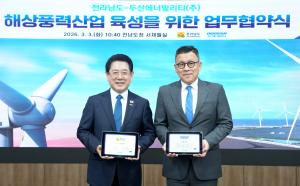
South Jeolla Province and Doosan Enerbility signed an MOU to strengthen offshore wind development and local manufacturing links in Korea. The deal underscores tighter public–private coordination.
Executive Insight
South Jeolla Province’s MOU with Doosan Enerbility is a clear signal that Korea’s offshore wind buildout is increasingly being framed as an industrial policy agenda—not only a power-generation one. By aligning a key coastal province with one of the country’s flagship heavy-industry groups, the agreement points to a more coordinated approach to regional project development, permitting readiness, and the creation of a domestically anchored supply chain. For a market that has faced stop-start momentum driven by local acceptance, grid constraints, and evolving tender rules, strengthened public–private coordination can help de-risk early-stage execution and improve bankability through clearer roles, timelines, and local stakeholder alignment.
For international offshore wind developers and investors, the implication is twofold. First, provinces like South Jeolla are positioning themselves as proactive platforms for development—potentially offering smoother site development pathways, coordinated infrastructure planning, and a more investable narrative around local benefits (jobs, manufacturing, port activity). Second, the growing emphasis on domestic industrial participation suggests procurement strategies will need to be adapted. Global OEMs, EPCs, and developers may face stronger expectations to partner locally, transfer know-how, and integrate Korean manufacturing where feasible. This can raise initial costs or complexity, but it can also improve long-term delivery certainty by building local capabilities in foundations, towers, substations, O&M services, and potentially turbine components as domestic capacity scales.
Strategically, this MOU reinforces the direction of travel: Korea is seeking to pair gigawatt-scale offshore wind ambitions with industrial competitiveness and regional economic development. Developers assessing pipeline opportunities in the southwest should track how such agreements translate into practical measures—port upgrades, workforce training, environmental and fisheries engagement frameworks, and clarity on grid connection planning. Investors should also watch whether provincial coordination helps shorten development cycles, since timeline certainty is often as valuable as headline subsidies when underwriting returns. In short, South Jeolla–Doosan cooperation may not change policy overnight, but it strengthens the ecosystem that will determine which projects reach construction—and how much value is captured domestically.