South Jeolla, Doosan Enerbility Tie Up to Accelerate Korea Offshore Wind Supply Chain
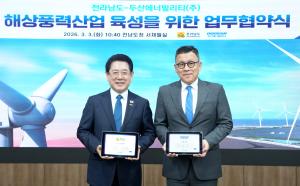
South Jeolla Province signed an MOU with Doosan Enerbility to promote offshore wind. The deal highlights tighter public–private coordination on project delivery and local manufacturing.
Executive Insight
South Jeolla Province’s March 3 memorandum of understanding (MOU) with Doosan Enerbility is a clear signal that Korea’s offshore wind buildout is moving into a more coordinated, industrial-policy phase. South Jeolla is one of the country’s most important coastal hubs for planned offshore wind capacity, and an explicit partnership with a major domestic OEM strengthens the province’s ability to package projects with a credible local execution and manufacturing story. For Korea’s renewables market, this matters because the binding constraint is increasingly not headline gigawatt targets, but bankable delivery: permitting progress, grid connection certainty, and the availability of a stable, competitive supply chain that can meet localization expectations without inflating costs.
For international investors and offshore wind developers, the MOU should be read as both an opportunity and a diligence trigger. The opportunity is clearer: stronger provincial backing can de-risk early-stage development by improving stakeholder alignment, unlocking industrial sites and port logistics planning, and accelerating workforce and supplier readiness. This can support more predictable construction schedules and potentially reduce interface risk between developers, turbine suppliers, and balance-of-plant contractors. However, the diligence trigger is equally important. Public–private coordination often comes with implicit expectations around local sourcing, preferred contractors, or regional economic deliverables. International players should assess how such arrangements may shape procurement flexibility, contracting strategy, and ultimately project IRRs—especially in a market where cost competitiveness is tightening and financing will increasingly reward clarity on execution pathways.
Strategically, this MOU reinforces three trends to watch in Korea: (1) provinces acting as de facto “project enablers” to overcome central-level bottlenecks; (2) the emergence of domestic champions positioning for turbine, foundations, and key component roles as Korea seeks supply security; and (3) growing emphasis on cluster development—ports, fabrication yards, and O&M bases—near high-potential sea areas. Overseas developers and investors may benefit from structuring partnerships that complement domestic manufacturing while preserving global best-practice standards in quality, HSE, and contract discipline. Early engagement with provincial stakeholders, plus a clear localization plan that does not undermine cost and schedule, will be critical to remaining competitive as Korea’s offshore wind market matures.